Why Good Composting Machines Fail in Bad Operations
Every year across Pune, Pimpri-Chinchwad, and Mumbai, hundreds of residential housing societies invest between ₹5 lakh and ₹25 lakh in an on-site organic waste composter to comply with the Solid Waste Management (SWM) Rules, 2016.
For the first two or three months, everything runs smoothly. The builder or vendor hands over the equipment, the ribbon is cut, and the committee takes pride in achieving zero-waste status. Yet, walk into residential garbage rooms 18 months later, and an alarming pattern emerges: machines switched off, piles of unsegregated trash overflowing around the hopper, and resident WhatsApp groups flooded with complaints about pungent, sour odours drifting up to 4th-floor balconies.
When an industrial composting machine fails in a residential society, the machinery is almost never the root cause. In over 90% of service audits conducted by Green Planet Solutions, the failure stems from a breakdown in daily operational protocols, moisture management, and operator accountability. Operating an In-Vessel composting system is simple, but it is not magic. It is an accelerated biological process that relies on living aerobic thermophilic bacteria. Here are the 5 most common operational mistakes housing societies make—along with the exact engineering fixes to keep your facility running odour-free for decades.
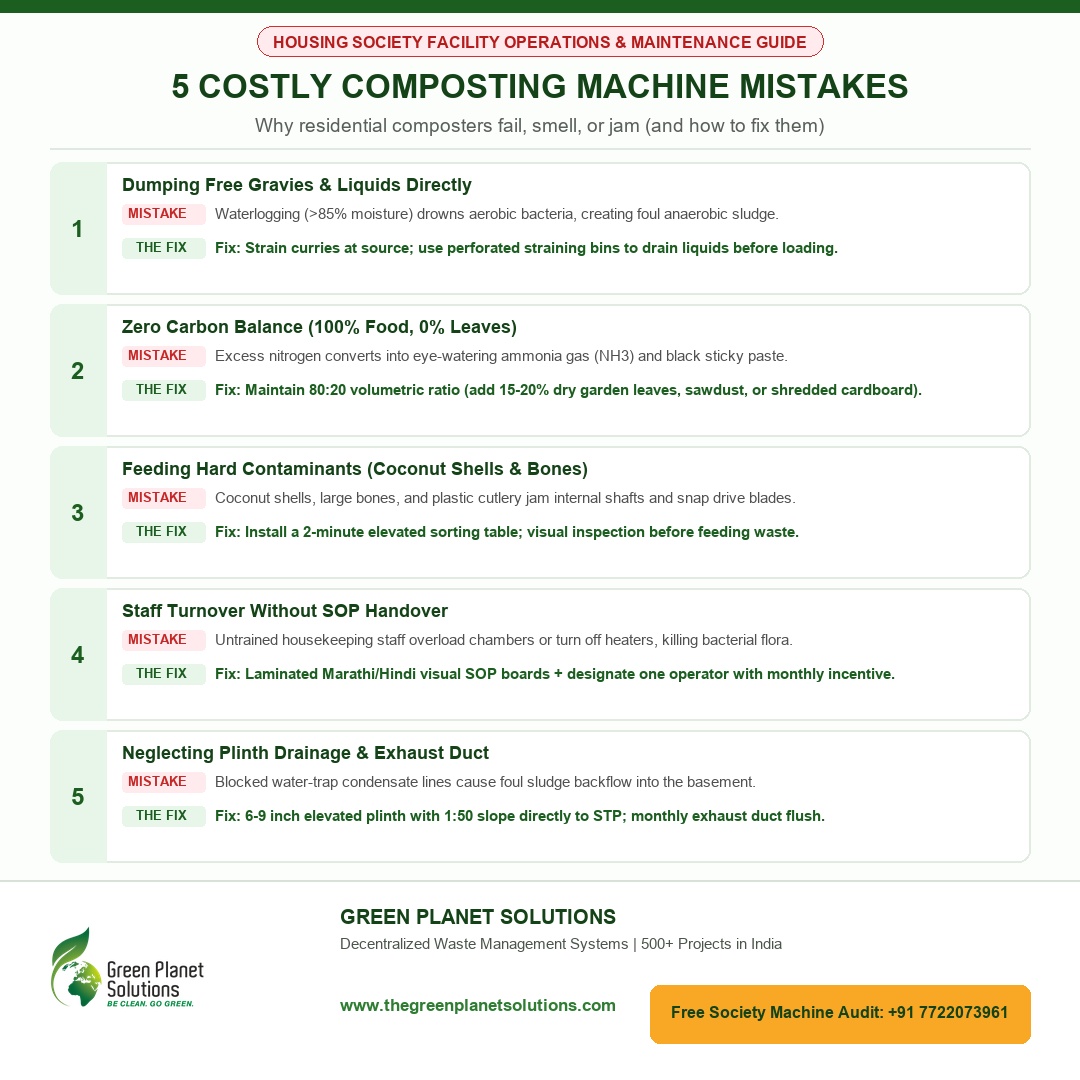
Visual Guide: 5 Fatal Mistakes When Operating a Society Composter & Daily Fixes
❌ Mistake #1: Dumping Free Liquid & Sambar Directly into the Hopper
THE CONSEQUENCEAerobic composting bacteria require oxygen and moisture. The sweet spot for in-vessel aerobic digestion is 50% to 60% moisture content. When housekeeping staff collect food bins from flats, they often dump liquid leftovers directly into the hopper—yesterday's dal, curd, tea dregs, sambar, watermelon rinds, and gravy. This spikes moisture levels inside the chamber beyond 80% to 85%.
Waterlogged air pockets completely suffocate the aerobic bacteria. Anaerobic microbes take over, producing pungent methane, hydrogen sulfide (rotten egg stench), and volatile organic acids. Furthermore, heating elements burn huge amounts of electricity trying to boil off excess water rather than sustaining biological thermophilic temperatures (55°C–65°C).
THE ENGINEERING FIXStrain at source and in the waste room: Instruct residents to strain curries and soups before placing wet waste into the kitchen bin (liquid curries belong in the kitchen sink drain connected to the STP). In the society garbage room, dump wet waste into perforated straining crates or an elevated stainless steel sorting table to allow free water to drain for 10–15 minutes before loading. For large townships (300+ flats), integrate an automated mechanical dewatering press directly ahead of the composter.
❌ Mistake #2: Zero Carbon Balance (All Food Scraps, No Dry Leaves or Sawdust)
THE CONSEQUENCEKitchen food waste is overwhelmingly rich in nitrogen (protein, dairy, cooked vegetables, carbohydrates). If you feed 100% kitchen scraps into a composter with zero carbon material, the Carbon-to-Nitrogen (C:N) ratio collapses below 10:1. The aerobic bacteria simply cannot utilize all that nitrogen to build cell structures. The excess nitrogen volatizes into ammonia gas ($NH_3$), creating an eye-watering, sharp, urine-like chemical stench that vents directly into resident parking and lower-floor balconies. The waste also collapses into a dense, sticky paste that adheres to internal shafts.
THE ENGINEERING FIXImplement the 80:20 Rule: For every 100 kg of wet kitchen waste fed into the machine, add 15 to 20 kg of dry carbon bulking agent. The ideal bulking agents are crushed dry garden leaves from society landscaping, plain carpentry sawdust, coco-peat, or shredded corrugated cardboard. Dry carbon absorbs excess liquid, restores the C:N ratio to an optimal 25:1–30:1, and creates microscopic air channels that keep the biological core rich in oxygen.
❌ Mistake #3: Feeding Hard Contaminants (Coconut Shells, Bones & Plastic)
THE CONSEQUENCEAn in-vessel composter is an accelerated bio-reactor, not a heavy quarry crusher. When housekeeping staff dump whole bags directly into the hopper, heavy contaminants sneak inside: whole coconut shells (naral kachra), thick mutton bones, mango seeds, plastic milk pouches, metal spoons, and delivery packaging. A coconut shell wedged between the rotating agitation blade and the vessel wall can sheer drive pins, bend shafts, strip gearbox teeth, and repeatedly trip MCCB circuit breakers. Plastic bags wrap around the agitator shaft, strangling rotation and shredding into microplastics that ruin the final compost quality.
THE ENGINEERING FIXMandatory 2-Minute Pre-Feed Visual Sorting Table: Ban direct bag dumping into the machine hopper. Set up an elevated, waist-height stainless steel sorting table right next to the machine. Staff empty collection bins onto the table and spend 120 seconds visually raking through the waste to pick out coconut shells, thick bones, plastic covers, and cutlery before sliding clean organic waste into the composter. Coconut shells can be set aside for a dedicated biomass shredder or garden mulching.
❌ Mistake #4: The "Fit-and-Forget" Fallacy & High Housekeeping Turnover
THE CONSEQUENCEFacility management contractors change their on-site housekeeping teams every 3 to 6 months. When the vendor trains Operator A during commissioning, Operator A understands the machine. But when Operator A leaves without formal handover, Operator B assumes the composter is an incinerator or a dump bin. Operator B overloads a 250 kg machine with 500 kg of accumulated trash over a holiday weekend, or turns off the main heater switch to "save power." The thermophilic bacteria die off from cold starvation, and the entire biological process collapses within 72 hours.
THE ENGINEERING FIXDesignated Certified Operator & Bilingual Visual SOPs: Designate one specific housekeeping staff member as the Primary Composter Custodian with a modest monthly performance allowance (₹500–₹1,000/month). Mount weather-proof, laminated Standard Operating Procedure (SOP) boards with clear picture diagrams in Marathi and Hindi directly above the control panel. Partner with your equipment manufacturer (such as Green Planet Solutions) to run quarterly retraining audits whenever housekeeping agencies rotate staff.
❌ Mistake #5: Neglecting Plinth Drainage & Exhaust Duct Maintenance
THE CONSEQUENCEAn active in-vessel composter evaporates dozens of liters of moisture daily as moisture is drawn off thermophilically. If the moisture condensation line or moisture trap is installed without a water seal, or allowed to clog with fine dust, condensate backs up into the machine plinth. Furthermore, washdown water pooling on a flat, un-sloped concrete floor creates stagnant puddles, attracting swarms of fruit flies and releasing foul basement smells even when the composter itself is operating perfectly.
THE ENGINEERING FIXElevated Plinth with Dedicated STP Drain: Always install the machine on an elevated concrete plinth (6 to 9 inches above floor grade) constructed with a 1:50 floor slope directed into a drain channel with an odour trap. Route washdown water and exhaust condensation lines directly into the society's Sewage Treatment Plant (STP) inlet line. Flush the exhaust duct and condensate trap with warm water once every month to prevent biological scale buildup.
The 5-Minute Daily Operator Protocol Checklist
Laminate this checklist and mount it directly beside your composter's control panel:
| Step | Action Required | Frequency |
|---|---|---|
| 1. Pre-Screen | Empty bins on sorting table. Remove plastics, coconut shells, cutlery, and large bones. | Daily (Before loading) |
| 2. Dewater | Strain free gravies, sambar, and liquids. Do not pour liquid soup into the hopper. | Daily |
| 3. Carbon Ratio | Add 15%–20% dry leaves, sawdust, or shredded cardboard per 100 kg wet food waste. | Daily |
| 4. Temperature Check | Verify digital panel temperature reads between 50°C and 65°C during active heating. | Daily (Afternoon) |
| 5. Discharge & Wash | Unload crumbly organic compost; hose down plinth ensuring washdown flows into STP drain. | Daily |
| 6. Condensate Flush | Flush exhaust moisture line and grease motor drive bearings as per OEM manual. | Monthly |
Is Your Housing Society Composter Smelly or Jammed?
Get a comprehensive on-site technical inspection, biological revival (re-seeding), and housekeeping staff retraining session from Green Planet Solutions engineers.
Request Free Composting Plant Health Audit →